
 Why Early Physiotherapy Matters in Parkinson’s Management
Parkinson’s disease is a progressive neurological condition that impairs movement, coordination and balance. While medications remain central to symptom management, early referral to physiotherapy offers significant advantages. For people newly diagnosed, engaging a physiotherapist sooner rather than later can make a meaningful difference in long-term mobility, independence and quality of life.
Understanding Parkinson’s disease
Parkinson’s disease (PD) arises when nerve cells in the brain that produce dopamine begin to deteriorate. As dopamine levels decline, movement becomes slower, muscles stiffen, posture changes and balance becomes less secure. Over time, these changes can compromise a person’s ability to walk safely, perform daily tasks and maintain independence. Importantly, many changes begin subtly but accumulate. Early physiotherapy provides an opportunity to intervene proactively before greater decline occurs.
Why early intervention matters
There are several key reasons why starting physiotherapy early in Parkinson’s management is beneficial:
- Preservation of physical reserve
At the early stage of PD, muscle strength, flexibility and postural control are relatively better preserved. Physiotherapy in this window helps optimise these systems before stiffness, weakness and postural changes become entrenched. Establishing strong mobility foundations allows for better resilience as the disease progresses. - Promotion of neuroplasticity and movement retraining
The brain retains the capacity to reorganise and adapt. Physiotherapists use exercises that encourage large amplitude movements, rhythm and coordination, which help the brain maintain efficient movement patterns. By beginning exercise-based retraining early, individuals may maintain better motor control and delay functional decline. - Prevention of secondary complications
Reduced movement, poor posture and gait changes can lead to joint contractures, falls, cardiovascular de-conditioning and reduced bone health. Early physiotherapy addresses these risks by maintaining mobility, promoting strength and improving balance. Preventing such complications supports longer-term independence. - Building confidence and an active habit
Early therapy is as much about education and habit formation as exercise. Physiotherapists help people understand their condition, set realistic goals, adapt their environment and maintain safe activity. This gives patients the confidence to stay active, reducing fear of falling or avoidance of movement.
 What early physiotherapy looks like in practice
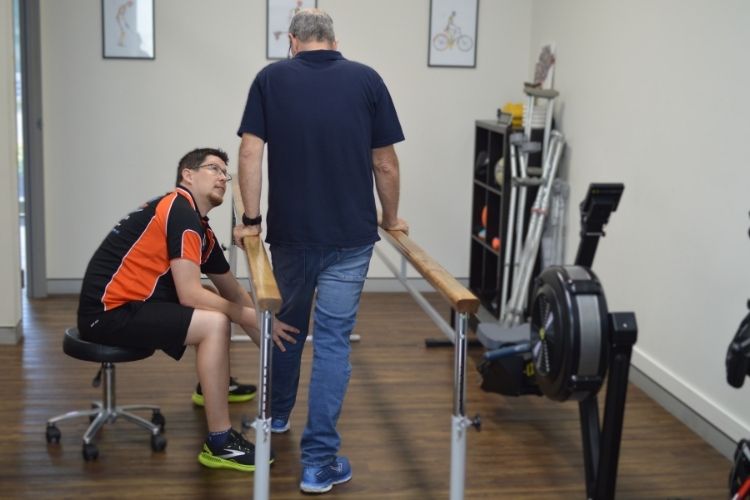
In a clinic setting, early physiotherapy for Parkinson’s typically involves several elements:
- Assessment and goal setting: The physiotherapist evaluates gait, posture, balance, strength, mobility and daily activity limitations. Together with the person living with PD, clear goals are identified.
- Posture and alignment training: Exercises to maintain upright posture, reduce stooping and promote trunk control.
- Gait and balance re-education: Techniques such as cueing strategies (auditory or visual prompts) and exaggerated stepping or arm swing to counteract shuffling or freezing of gait.
- Amplitude-based movement training: Encouraging larger, more deliberate movements to offset the tendency toward smaller and slower motions typical of PD.
- Strength and flexibility work: Regular strength training and stretching to maintain muscle power and joint mobility.
- Home exercise and self-management: A vital component. Physiotherapists will prescribe exercises to be done at home and provide strategies to integrate movement into everyday life. Early establishment of this routine means patients are more likely to keep moving even when visits become less frequent.
Linking therapy to lifestyle activity
Physiotherapy works best when complemented by ongoing activity. Australian guidelines emphasise that exercise is perhaps the most effective non-medication option for people living with Parkinson’s. Regular aerobic, strength, flexibility and balance/neuromotor exercise, maintained over the long term, can improve mobility, balance, mood and even slow the rate of decline. Starting this early makes habit formation easier and reduces the likelihood of activity drop-off.
The emotional and social benefits of early therapy
Living with Parkinson’s presents more than just physical challenges. Loss of confidence, fear of falling, social isolation and change in identity are common. Early physiotherapy offers support beyond movement. It builds routine, social contact (in group classes or clinic visits), and provides hope. Knowing a plan is in place helps reduce anxiety and encourages participation in meaningful daily activities.
Working as part of a wider team
Physiotherapy is one component of a multidisciplinary approach to Parkinson’s care. It works alongside neurologists, occupational therapists, speech pathologists and allied health practitioners. Early physiotherapy helps coordinate care, identify when additional supports are needed, and integrate movement strategies into the broader management of the condition. Australian physiotherapy guidelines note the importance of early referral and ongoing intervention.
Conclusion: A proactive path forward
The message is clear: don’t wait for major mobility problems before initiating physiotherapy. The earlier you engage a physiotherapist, the greater the chance of maintaining independence, movement confidence and quality of life. Early intervention in physiotherapy empowers people living with Parkinson’s to keep doing what matters to them—and to do so for longer. If you or someone you know is newly diagnosed with Parkinson’s disease, consider arranging a physiotherapy assessment. A tailored, early intervention plan helps build strength, promote safe movement and support an active and meaningful life.
References
Australian Physiotherapy Association. Physiotherapy management of Parkinson’s disease. 2021. Available at: https://australian.physio/home/physiotherapy-management-parkinson%25E2%2580%2599s-disease Australian Physio
Centre for Neuro-rehabilitation, Ageing and Balance Research (University of Queensland). Access to physiotherapy for patients with Parkinson’s disease attending the Royal Brisbane and Women’s Hospital. Available at: https://shrs.uq.edu.au/nab-research-centre Health & Rehab Sciences
Parkinson’s Australia. Exercise – Parkinson’s Australia. Available at: https://www.parkinsons.org.au/information-hub/exercise/ Parkinson’s Australia
Parkinson’s Australia. Types of exercise recommended for Parkinson’s. Available at: https://www.parkinsons.org.au/information-hub/exercise/types/ Parkinson’s Australia
RACGP. Exercise for Parkinson’s disease. Available at: https://www.racgp.org.au/clinical-resources/clinical-guidelines/handi/handi-interventions/exercise/exercise-for-parkinson-s-disease RACGP
Pang MYC, et al. Physiotherapy management of Parkinson’s disease. Australian Physiotherapy Journal. 2021. Available at: https://pwaparkinsonswa.blob.core.windows.net/assets/contentpage_htmlcontent/Pang_2021_Physio-management-of-PD-00000002.pdf pwaparkinsonswa.blob.core.windows.net